
 Available in US
- Understanding Fractional Odds Format
- Decimal Odds and Their Growing Popularity
- How the Pari-Mutuel System Determines Odds
- Morning Line vs. Post-Time Odds
- Step-by-Step Payout Calculation Guide
- Complete Odds-to-Payout Reference
- Understanding Favorites, Longshots, and Overlays
- Tips for Finding Value in the Odds
- Conclusion
Horse racing odds can look like ancient hieroglyphics to newcomers. Those fractions on the tote board, the numbers shifting every few minutes, the morning line that never quite matches what you see at post time — it all creates an intimidating wall between casual fans and confident bettors. The truth is, understanding horse racing odds is not rocket science. Once you grasp the underlying logic, you will find yourself reading the board like a seasoned railbird.
This guide breaks down everything you need to know about horse racing odds. We will cover the two main formats you will encounter, explain how the pari-mutuel system creates those numbers, and teach you to calculate your potential payout before you slide your money across the counter. By the end, you will understand why that 3/1 shot looks attractive while the 1/5 favorite might not be worth the risk.
The ability to read odds quickly separates recreational bettors from those who consistently find value. When you understand what the numbers mean, you can spot opportunities that others miss. You can identify when a horse is over-bet by the public and when a legitimate contender is being overlooked. This knowledge does not guarantee winners, but it gives you the foundation to make smarter decisions with your money.
Understanding Fractional Odds Format
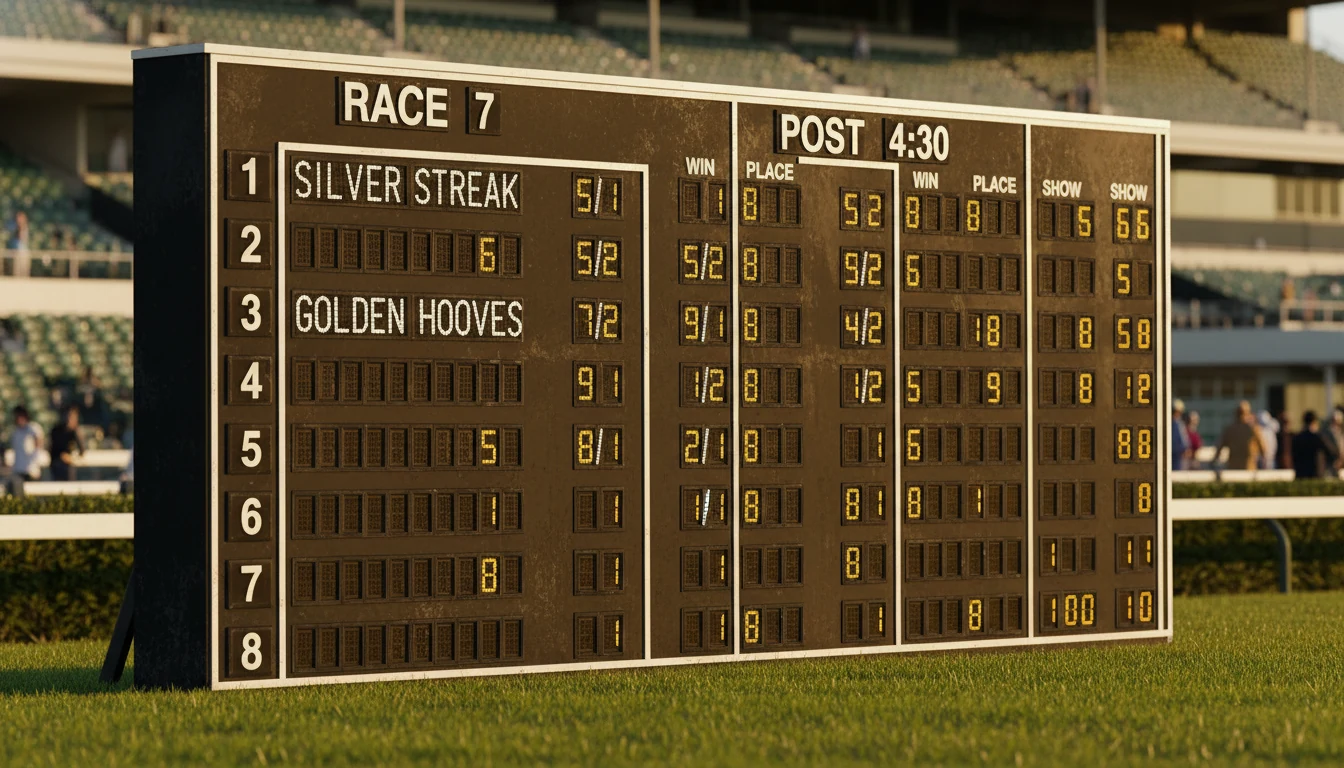
Fractional odds represent the most traditional way of displaying horse racing prices, particularly at tracks in the United States and United Kingdom. When you see a horse listed at 5/1, you are looking at a ratio that tells you how much profit you will make relative to your stake. The first number represents potential profit, and the second number represents the amount you need to wager to earn that profit.
A horse at 5/1 (spoken as “five to one”) means you will win five dollars for every one dollar you bet. If you place a twenty-dollar wager on a 5/1 shot and the horse wins, you collect one hundred dollars in profit plus your original twenty-dollar stake, for a total return of one hundred twenty dollars. The math follows a simple formula: multiply your stake by the first number, divide by the second number, then add your original wager to find the total return.
Not all fractional odds look as clean as 5/1. You will frequently encounter prices like 7/2, 9/5, or 6/5. These odd-looking fractions work exactly the same way. A horse at 7/2 pays three dollars and fifty cents for every dollar wagered — multiply seven by your stake, divide by two, and you have your profit. A twenty-dollar bet on a 7/2 winner returns seventy dollars in profit plus your twenty-dollar stake.
The fractions also tell you something important about how the betting public views each horse. Lower fractions like 1/5 or 2/5 indicate heavy favorites. A 1/5 shot means you must risk five dollars to win just one dollar in profit. The public has poured so much money on this horse that the potential return has become minimal. These odds suggest strong confidence from bettors, though that confidence does not always prove justified.
Higher fractions signal longshots. A horse at 20/1 or 30/1 is considered unlikely to win by the betting public. However, these horses offer substantial payouts when they do cross the finish line first. A fifty-dollar bet on a 30/1 winner returns fifteen hundred dollars in profit. The tradeoff is clear: lower risk horses offer lower rewards, while higher risk horses offer the potential for significant payouts.
Understanding the relationship between odds and implied probability helps you evaluate whether a price offers value. To convert fractional odds to implied probability, divide the second number by the sum of both numbers. A 4/1 horse has an implied win probability of twenty percent (1 divided by 5). A 1/4 favorite has an implied probability of eighty percent (4 divided by 5). These percentages represent what the betting market believes about each horse’s chances.
Decimal Odds and Their Growing Popularity

While fractional odds dominate American racetracks, decimal odds have gained significant traction globally and across online betting platforms. European betting exchanges, Australian racebooks, and many international ADW sites display prices in decimal format. Understanding both systems allows you to bet comfortably regardless of which platform you choose.
Decimal odds express the total return on a one-unit stake, including your original wager. A horse listed at 6.00 in decimal odds means you receive six dollars back for every dollar bet — five dollars profit plus your one-dollar stake. The equivalent fractional odds would be 5/1. A decimal price of 3.50 equals fractional odds of 5/2, returning three dollars and fifty cents for every dollar wagered.
The conversion between formats is straightforward. To convert fractional odds to decimal, divide the first number by the second and add one. Fractional odds of 9/4 become decimal odds of 3.25 (9 divided by 4 equals 2.25, plus 1 equals 3.25). To convert decimal odds back to fractional, subtract one and express the result as a fraction. Decimal odds of 4.00 become 3/1 (4.00 minus 1 equals 3, expressed as 3/1).
Many bettors prefer decimal odds because the math becomes simpler, especially when comparing prices across multiple horses or calculating potential returns on exotic wagers. You simply multiply your stake by the decimal odds to find your total return. A fifty-dollar bet at decimal odds of 4.50 returns two hundred twenty-five dollars total. No need to calculate profit separately and then add your stake.
Decimal odds also make it easier to identify slight price differences between horses. The gap between 5/2 and 11/4 might not seem obvious at first glance, but 3.50 versus 3.75 immediately shows a quarter-unit difference per dollar wagered. This clarity matters when you are shopping for the best price or trying to identify value in a crowded field.
How the Pari-Mutuel System Determines Odds

Horse racing operates differently from most other forms of sports betting. Instead of betting against a bookmaker who sets fixed odds, you are betting into a pool alongside all other bettors. The track acts as an intermediary, not as an opposing party. This system, called pari-mutuel wagering, has shaped horse racing betting since its introduction in the late nineteenth century.
The term “pari-mutuel” comes from French, meaning “mutual betting.” All wagers on a particular race go into a common pool. The track takes its cut — known as the takeout — which typically ranges from fifteen to twenty-five percent depending on the bet type and jurisdiction. The remaining money gets distributed among winning ticket holders proportionally to their wagers.
This pooling mechanism explains why horse racing odds fluctuate constantly before post time. Every new bet changes the composition of the pool and shifts the potential payouts. When money floods in on a particular horse, that horse’s odds drop because more bettors will share the payout if it wins. When a horse attracts little action, its odds rise because fewer bettors will split the pool.
Consider a simplified example. Suppose a win pool contains ten thousand dollars, and the track takeout is twenty percent. After the takeout, eight thousand dollars remains for distribution. If four thousand dollars was bet on the winning horse, each dollar wagered on that horse returns two dollars (eight thousand divided by four thousand). The effective odds are 1/1, or even money.
The pari-mutuel system creates what some call a “betting market” for each race. Prices reflect the collective wisdom — or collective folly — of everyone wagering. Heavy betting on favorites drives their odds down, while neglected horses offer higher potential returns. The market tends to be roughly efficient over time, meaning favorites win more often than longshots, but individual races produce surprises that keep everyone engaged.
Understanding takeout rates matters for long-term profitability. Win, place, and show pools typically carry takeout rates between fifteen and eighteen percent. Exotic wagers like trifectas and superfectas often face takeout rates exceeding twenty percent. This mathematical edge for the track means bettors must overcome a significant hurdle to profit consistently. Selecting winners is only part of the equation — finding value at prices that compensate for the takeout is essential.
Morning Line vs. Post-Time Odds
Every race card includes a morning line, which represents the track handicapper’s prediction of what the final odds will be at post time. This early estimate serves as a starting point for bettors to evaluate the field before money starts flowing into the pools. The morning line appears in programs and daily racing forms, giving you a baseline for comparison.
Morning line odds are not predictions of which horse will win. They are predictions of how the betting public will wager. A track handicapper setting the morning line must balance their assessment of each horse’s ability against their understanding of betting patterns. A talented but overlooked shipper might deserve lower odds based on performance, but the handicapper knows the local crowd will likely ignore it.
The gap between morning line and post-time odds reveals valuable information. When a horse opens at 8/1 on the morning line but goes off at 4/1, significant money has come in on that runner. This “steam” might indicate sharp bettors with inside information, stable confidence, or simply public overreaction to recent performance. Conversely, a horse drifting from 3/1 to 6/1 suggests the market has soured on its chances.
Smart bettors use morning line comparisons as one tool among many. Horses that hold or exceed their morning line odds while showing legitimate contention in the race shape often represent value opportunities. The public has ignored them despite solid credentials. Those that attract money beyond their apparent merit might be “false favorites” inflated by name recognition or recent wins in weaker company.
Post-time odds represent the final market assessment, but they freeze only moments before the gates open. Late money sometimes causes dramatic shifts in the last minutes before a race. Some sharp bettors deliberately wait until the final moments to disguise their action and avoid moving the odds against themselves. Watching the tote board in those closing minutes can reveal which horses are attracting last-second interest.
Step-by-Step Payout Calculation Guide
Calculating potential payouts before placing a bet allows you to evaluate whether a wager offers adequate return for the perceived risk. The calculations vary slightly depending on bet type, but all follow logical patterns once you understand the underlying mechanics.
Win Bet Calculations
For win bets, the calculation is straightforward. Take the fractional odds, multiply your stake by the first number, divide by the second number, and add your original stake. A thirty-dollar win bet on a horse at 7/2 produces the following: thirty multiplied by seven equals two hundred ten, divided by two equals one hundred five dollars profit, plus your thirty-dollar stake equals one hundred thirty-five dollars total return.
With decimal odds, simply multiply your stake by the decimal price. That same thirty-dollar bet at decimal odds of 4.50 returns one hundred thirty-five dollars (thirty multiplied by 4.50). The result matches perfectly, which confirms the two systems express the same information differently.
Place and Show Calculations
Place and show payouts are harder to predict precisely because the pool gets split among bettors on multiple finishing horses. A place bet requires your horse to finish first or second. If it does, you share the place pool with everyone who bet on both the first and second-place finishers. Your payout depends not only on your horse’s odds but also on how much money was bet on the other horse in the top two.
Show betting works similarly but splits the pool three ways. Your horse must finish in the top three, and your return depends on the betting distribution across all three finishers. Exotic payouts on big longshots sometimes occur when two or three lightly-bet horses fill the top positions, leaving fewer bettors to share the pool.
Exotic Bet Estimation
Predicting exact exotic payouts before a race is essentially impossible because you cannot know which horses will finish in which positions. However, you can estimate potential returns by examining the will-pays displayed on the tote board and extrapolating based on current odds.
For exacta estimation, some bettors multiply the win odds of their top selection by the place odds of their second selection and then multiply by their wager. This provides a rough ballpark figure, though actual results vary based on pool distribution. Trifecta and superfecta estimation follows similar logic but compounds quickly into territory where precise prediction becomes guesswork.
The tote board displays probable payouts for straight exacta combinations during the betting period. These numbers update as money flows into the pools, giving you real-time information about potential returns. Use these displays to identify which combinations offer value relative to your assessment of likely finishes.
Complete Odds-to-Payout Reference
Having a quick reference for common odds saves mental energy at the track. Instead of calculating every potential payout, you can glance at this guide and know immediately what your bet will return if successful. The following figures show the return on a two-dollar wager, the standard base bet at most American racetracks.
At odds of 1/5, a two-dollar win bet returns two dollars and forty cents total. This tight return reflects overwhelming favorite status — the betting public has judged this horse as nearly certain to win. Moving up the odds ladder, 1/2 returns three dollars, 3/5 returns three dollars and twenty cents, 4/5 returns three dollars and sixty cents, and even money (1/1) returns four dollars.
For horses in the low single digits, 6/5 returns four dollars and forty cents, 7/5 returns four dollars and eighty cents, 3/2 returns five dollars, 8/5 returns five dollars and twenty cents, and 9/5 returns five dollars and sixty cents. These prices typically represent second or third choices in the betting.
Mid-range odds offer more substantial returns. Odds of 2/1 return six dollars, 5/2 return seven dollars, 3/1 return eight dollars, 7/2 return nine dollars, and 4/1 return ten dollars. Many experienced bettors focus on this range, seeking horses with legitimate chances that offer meaningful payouts.
Higher odds promise significant returns. Prices of 5/1 return twelve dollars, 6/1 return fourteen dollars, 7/1 return sixteen dollars, 8/1 return eighteen dollars, and 9/1 return twenty dollars. These represent genuine longshots in most fields, though some races with large fields see contenders at these prices.
At the upper end, 10/1 returns twenty-two dollars, 15/1 returns thirty-two dollars, 20/1 returns forty-two dollars, 30/1 returns sixty-two dollars, and 50/1 returns one hundred two dollars. Hitting a longshot at these prices creates memorable paydays, though consistency at this range challenges even professional handicappers.
Converting these to larger wagers is simple multiplication. For a twenty-dollar bet instead of two dollars, multiply the returns by ten. A 4/1 shot returning ten dollars on a two-dollar bet would return one hundred dollars on a twenty-dollar bet.
Understanding Favorites, Longshots, and Overlays
The betting favorite in any race is simply the horse with the lowest odds — the one that the collective betting pool has deemed most likely to win. Favorites win approximately thirty-three percent of the time in thoroughbred racing, which sounds reasonable until you consider that betting favorites blindly produces consistent losses due to the takeout. The market prices them efficiently enough that their returns rarely compensate for the risk.
Longshots sit at the opposite extreme. These horses at 10/1 or higher win far less frequently, perhaps five to eight percent of the time depending on where you draw the line. However, when they do win, the payouts can be substantial enough to cover multiple losing bets. Some handicappers specialize in identifying live longshots — horses whose true chances exceed what their odds suggest.
The concept of overlay describes the most valuable betting situations. An overlay occurs when a horse’s odds exceed what their actual probability of winning would justify. If you assess a horse as having a twenty-five percent chance to win (fair odds of 3/1), and it goes off at 6/1, you have found an overlay. The potential return more than compensates for the perceived risk.
The opposite situation — an underlay — happens when horses attract more betting support than their chances warrant. Underlays often occur with famous trainers, popular jockeys, horses coming off impressive visual wins, or runners with appealing names that catch the public’s attention. These horses might win, but their odds offer poor value relative to their actual probability.
Identifying overlays and underlays requires developing your own assessment independent of the betting market. This means studying past performances, understanding track conditions, evaluating trainer and jockey patterns, and recognizing situations where public perception likely diverges from reality. The market is smart but not infallible, and edges exist for those willing to do the work.
Public betting often overvalues recent form and undervalues horses stepping up in class or making their first start after a layoff. Studying patterns in how different types of horses outperform or underperform their odds helps identify where systematic value might exist. This systematic approach beats random shot-taking at longshots, which entertainment value aside, rarely produces positive returns.
Tips for Finding Value in the Odds

Finding betting value requires thinking differently than the crowd. Most bettors react to surface-level information — a horse won last time, a jockey is hot, a trainer ships in for a big race. This reactive betting creates opportunities for those who dig deeper and develop independent opinions.
Focus on situations where public perception likely differs from reality. Horses making their second start off a layoff often improve dramatically while the public focuses on a dull return race. First-time route runners stretching out from sprints may show unexpected stamina that morning line makers underestimate. Horses dropping in class after racing against tougher competition face easier tasks than their recent results suggest.
Track conditions create value opportunities. Some horses have pronounced preferences for off-track conditions that casual bettors overlook. A horse whose record reads poorly might have exceptional wet-track form buried in their past performances. When rain hits and the track comes up muddy, these specialists can offer overlay prices because the public has focused only on recent dry-track performances.
Late odds movement tells stories. Sharp money often comes in late, and watching for sudden, significant drops in odds can alert you to horses receiving professional support. Conversely, horses drifting upward in odds despite morning line expectations might be giving you a warning.
Conclusion
Reading horse racing odds is a skill that improves with practice. Start by mastering fractional and decimal formats until conversion becomes automatic. Understand that pari-mutuel betting differs fundamentally from fixed-odds wagering — you are betting against other bettors, not against the house. Learn to compare morning line predictions against actual post-time odds to identify where public money has flowed.
The ability to quickly calculate potential payouts lets you evaluate risk-to-reward ratios on the fly. Recognizing overlays versus underlays transforms random betting into strategic wagering. Whether you prefer backing favorites for steady but modest returns or hunting longshots for occasional windfalls, understanding odds gives you the foundation to make informed decisions every time you approach the betting window.
Recommend
Prepared by the horseracingb editorial staff.
